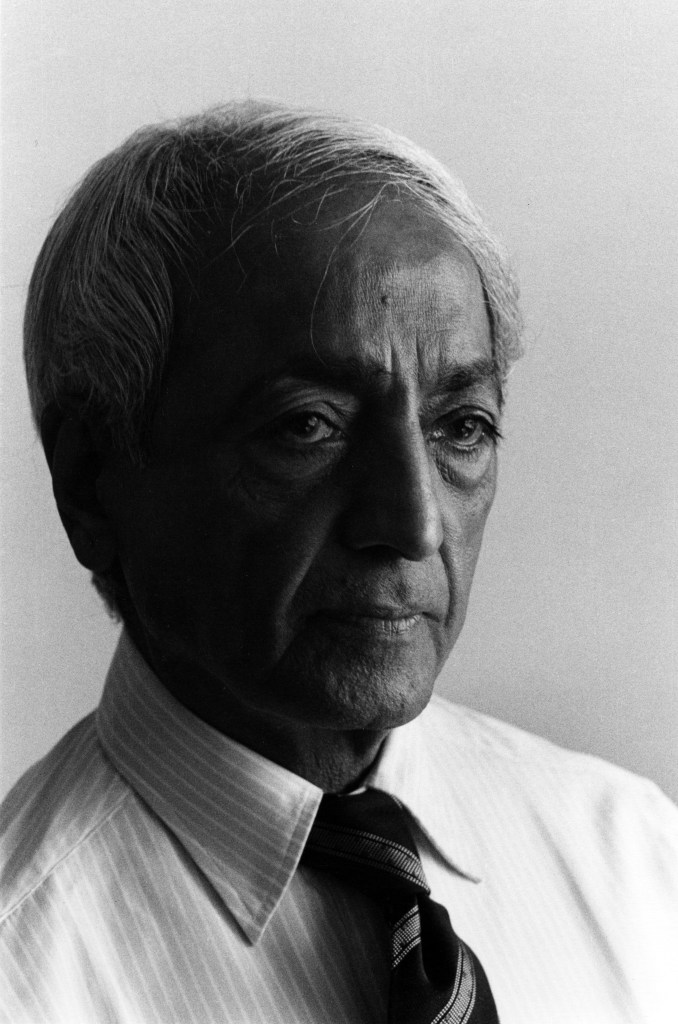
“Don’t be committed to any religion, to any so-called spiritual organisation, don’t follow any guru, and therefore have no authority whatsoever, including that of the speaker.”
Photograph by Mark Edwards, copyright Krishnamurti Foundation Trust (1968)
Krishnamurti frequently denied authority in spiritual affairs. This denial contrasts with many organized religions, in which the pronouncements of a leader are authoritative. With that in mind, how does The Twin Mode Mind relate to Krishnamurti’s work?
I suggest that followers of organized religions are like passengers in the taxi of life. They place all their trust in the driver, hoping to exchange their devotion for salvation. For Krishnamurti, I suggest, each of us alone is the driver, without passengers, navigators or instructions on how to drive. Nor is there a destination, map, or route.
The Twin Mode Mind asks: what lies under the bonnet and how does it relate to the mind of an effective driver? How does nature behave and how would the mind of someone without conflict operate? It considers the mechanics, the nuts-and-bolts of the taxi, without myself claiming any personal abilities as a driver.
Within the terminology of Western philosophy, “looking under the bonnet” in this analogy is equivalent to engaging in metaphysics. Considering “the mind of an effective driver” takes us into the philosophy of mind. Time is a vibrant part of Krishnamurti’s work, as it is in current philosophy. These areas of philosophy are explored in The Twin Mode Mind.
